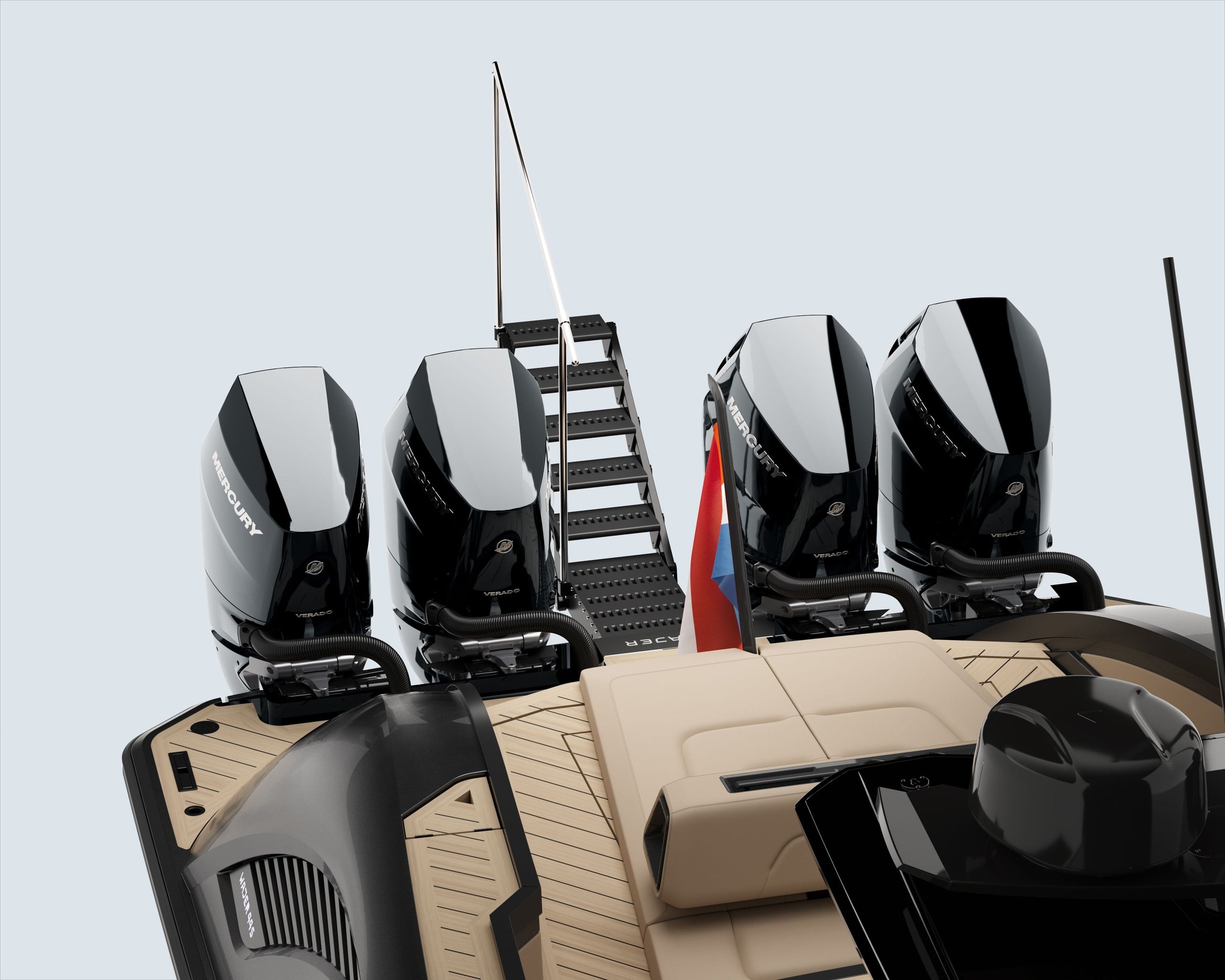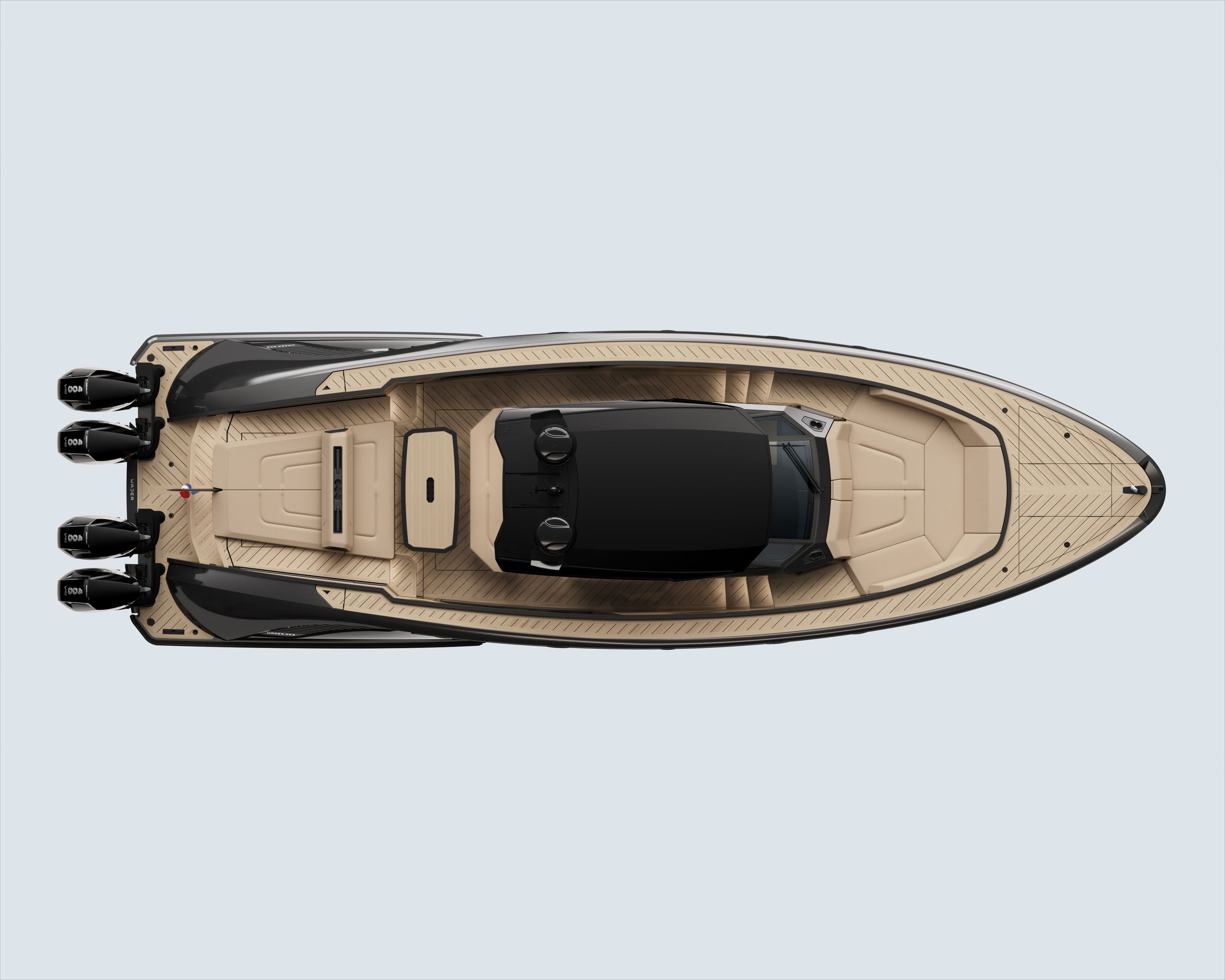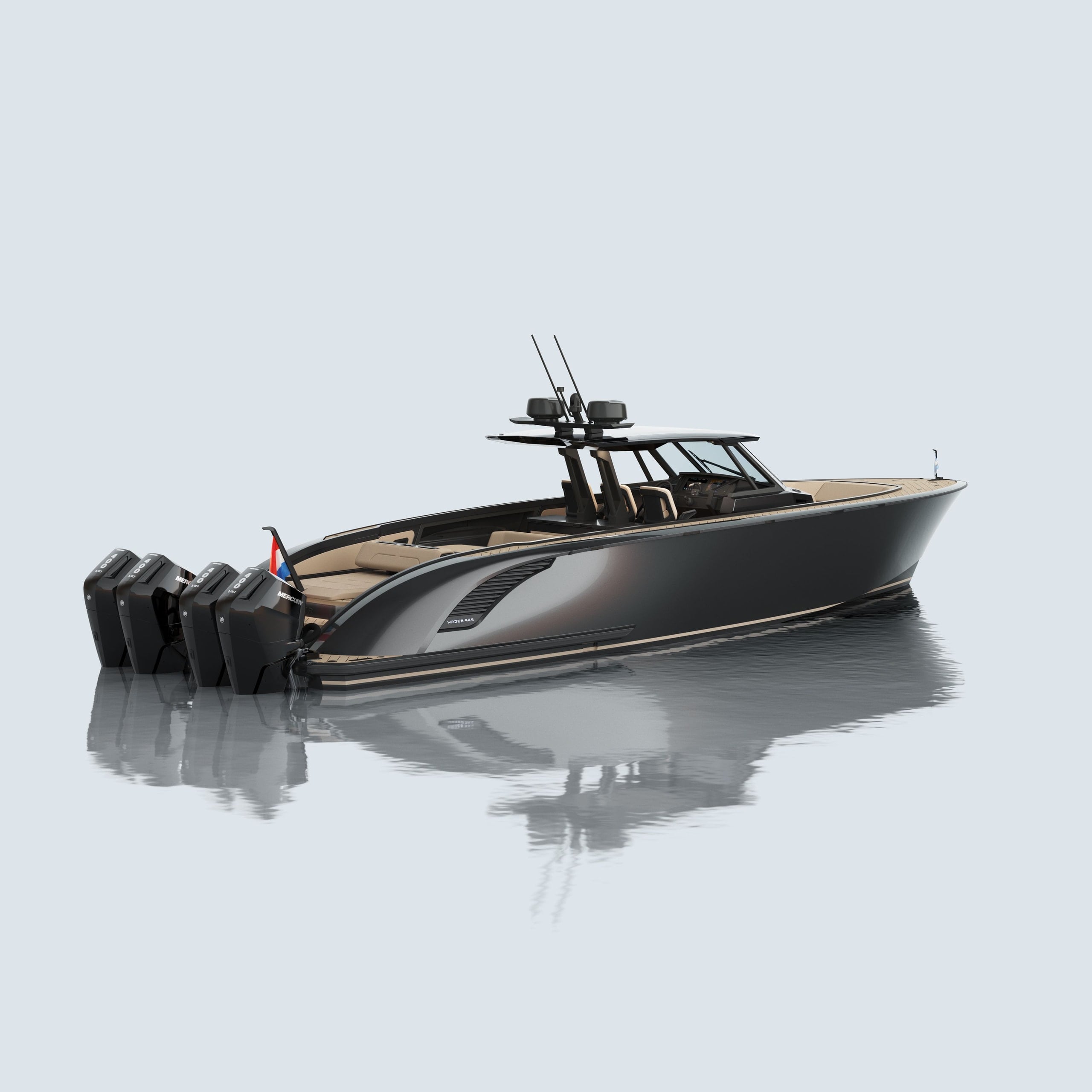
Wajer's headline is straightforward: the 44 S and 44 HT can now be ordered with twin Mercury V10 Verado outboards instead of the established Volvo Penta IPS pod drive. The 38 S got the same treatment last season; the move up to the 44 was the next step. The press release frames it as a US-market response. That's the surface read. The harder question — and the one we get from captains and owners weighing a 44 — is what the propulsion choice actually changes about the boat you're committing to for ten years.
What's actually new
Two 400-horsepower Mercury V10 Verado outboards, hung on a re-profiled transom, replacing the twin Volvo Penta IPS-650 pods that have been the 44's standard drive since the platform launched. Headline numbers Wajer has put on record: roughly equivalent top-end performance, broadly comparable fuel burn at cruise, and a service-and-storage profile that's notably easier in shallow-water harbours. Joystick control stays — Mercury's Skyhook station-keeping and joystick docking come as part of the V10 package, so the 44 retains the easy-handling story that was a big part of why owners specified IPS in the first place.
For US buyers, the move solves a service-and-warranty problem that hasn't gone away: Mercury's dealer network is denser and more consistent on the East Coast and in the Caribbean than Volvo Penta's IPS specialist coverage. For European and Mediterranean owners, the choice now exists but the IPS option is unlikely to disappear; Wajer has historically built more European hulls to IPS than outboard, and the supply chain is set up for both.
The case for outboards on a 44-class day boat
Three things move in the owner's favour when you choose outboards on this size of hull.
Service access is a different category of easy. An IPS pod lives below the waterline. Annual service involves either a lift or a diver, and any meaningful repair pulls the boat. A Verado V10 unbolts, tilts, and — at the extreme — comes off the transom and goes onto a workbench. In a programme where the 44 is being run hard between Med charters or moved between the Bahamas and Florida, that delta in service downtime adds up.
Shallow-water flexibility goes up. Outboards tilt clear of the water. The IPS pods don't. For a 44 that's expected to nose into beaches, run sandbars, or sit at anchor in genuinely shallow water without grounding the drives, the outboard option opens up territory the IPS variant has to avoid. This is the practical case behind the US-market framing — the Bahamas, Florida flats, and the Caribbean shoulder seasons reward boats that can run at 2 feet of draft when they need to.
Resale optionality. US-market boats with outboards trade in a deeper second-hand pool than US-market boats with IPS pods. Not by a huge margin, but enough to matter on a ten-year programme. In Europe the picture is the reverse — IPS has the depth.
Where the IPS still wins
The pod isn't going away on this platform, and the brief has to be honest about why.
Cabin volume aft. Outboards eat transom real estate that the IPS variant gives back to the cockpit and the lazarette. On a 44 HT the difference is not trivial — the IPS layout buys you a more usable swim platform and a deeper lazarette for tender, generator, and water-toy stowage. For a yacht-tender role where guests are coming and going through the transom multiple times a day, the IPS layout reads better.
Noise and motion at cruise. Pod drives are quieter at displacement and semi-displacement cruise speeds. The hull-mounted V8 diesels sit on engine beds with proper isolation; the V10 outboards transmit more mechanical noise into the helm and aft cockpit. On a flat morning at 22 knots, the IPS boat is the more relaxed boat.
Joystick subtleties. Mercury's joystick is excellent. Volvo's is, if you sit a captain down with both and run a tight Med marina manoeuvre, still the slightly more refined system. Both are good. The IPS edge is real but small.
Fuel burn at sustained cruise. Diesels still win on burn at long cruise speeds and on range. The 44's fuel tankage is the same regardless of drive choice, so the IPS variant goes further on a tank — material on long delivery runs, marginal on day-boat duty.
What this means for a brief
For a US-flagged 44 running primarily in the Caribbean, the Bahamas, or the East Coast, the outboard option is now the default we'd consider first. The service network, the shallow-water access, and the resale pool all point that way, and the cockpit-volume trade-off is more tolerable on a day-running programme than on a heavy yacht-tender brief.
For a European-flagged 44 — and especially for a Mediterranean tender role serving a 60m+ mothership — the IPS variant is still the brief we'd open with. The reliability story, the quieter cruise, and the deeper lazarette matter more than the marginal service convenience. The shallow-water case rarely tips the decision in a Med programme.
The third path is the interesting one, and it's the conversation we expect to have more of: a custom 44 ordered with outboards for a US-based programme that doesn't currently exist on any Mediterranean-flagged yacht. Wajer is set up to build both. The price delta isn't material on a boat at this level; the operational profile is the entire story.
If you're sourcing a 44 in the next eighteen months, the propulsion choice is the first decision and it shapes the rest of the spec. We'd rather have that conversation now than after the deposit.