Pascoe · New build
10.4m TL Limousine
10.4m
Length
36kt
Top Speed
16
People
Prices on request
Limo tenders for superyachts and mega yachts, new-build and pre-owned: climate-controlled cabins for quiet, dry, formal arrivals. Builders, custom limousine tender options and prices, or brief us for a shortlist.
For sale now
2 boats
New build, to order · priced within one working day
Guide
A limousine tender is the enclosed transport boat that moves owner and guests between yacht and shore in any weather, in formal dress, without spray reaching the hairline. The cabin is air-conditioned, the door seals are car-grade, the helm is forward and separated, and the boat looks more like a small yacht than a tender. It is the most visible asset on a programme and the one owners ask for first when they upgrade.
This page covers what makes a limousine tender different to an open guest tender, the spec inputs that matter, the builders who define the segment, and what the asset costs.
There is no formal definition. By convention a limousine tender has:
Below 8 metres the format is hard to make work because the cabin volume becomes claustrophobic. Above 14 metres the boat is no longer a tender in any honest sense, it is a chase boat with a limo deck. The mainstream is 8.5 to 12 metres.
A common variant is the limo-tender or "convertible limo", which has a removable hardtop or retractable roof that lets the cabin open up for fair-weather use. It is a useful compromise on a programme that does not have garage volume for both a limo and an open tender. See convertible limo tenders for the format breakdown.
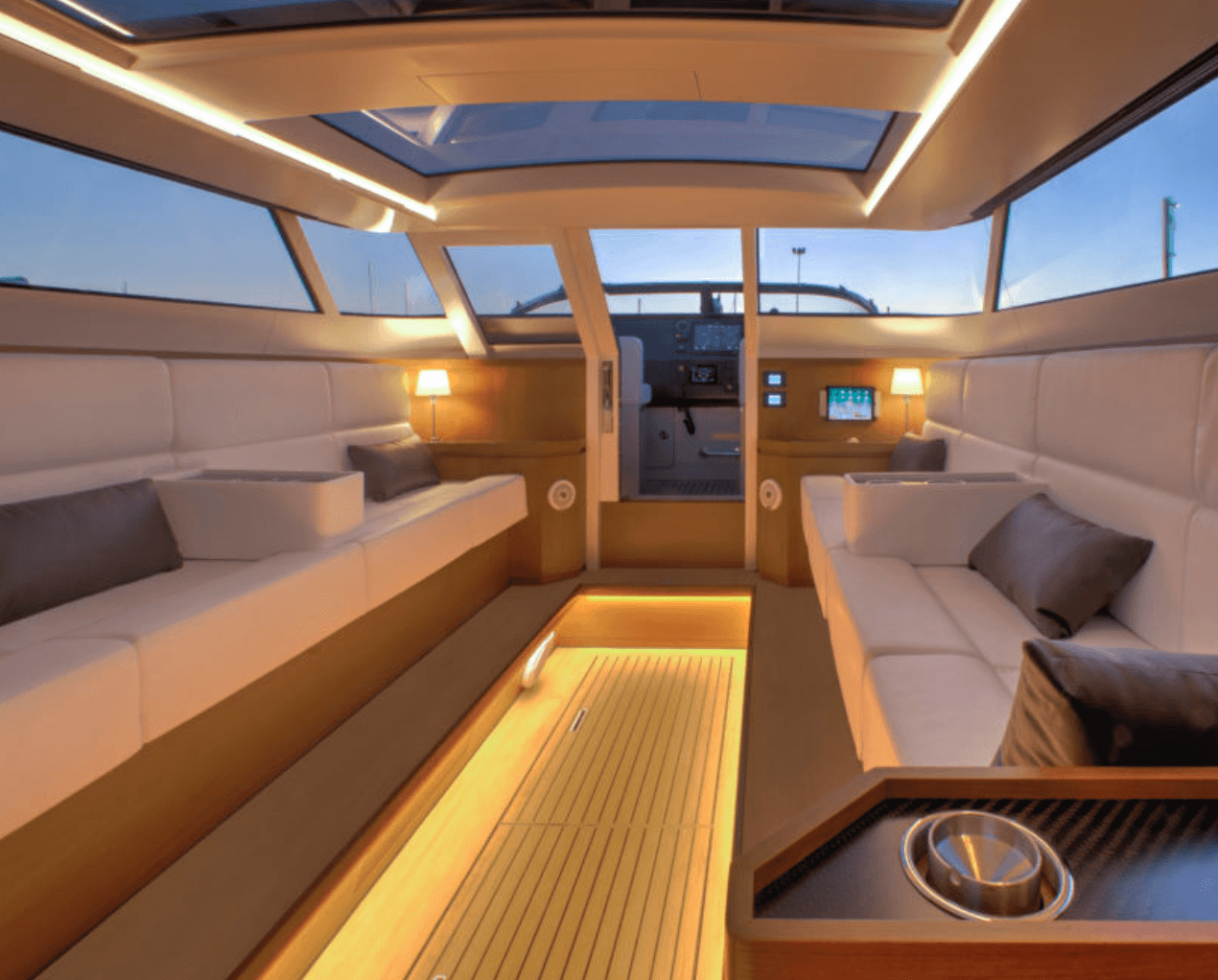
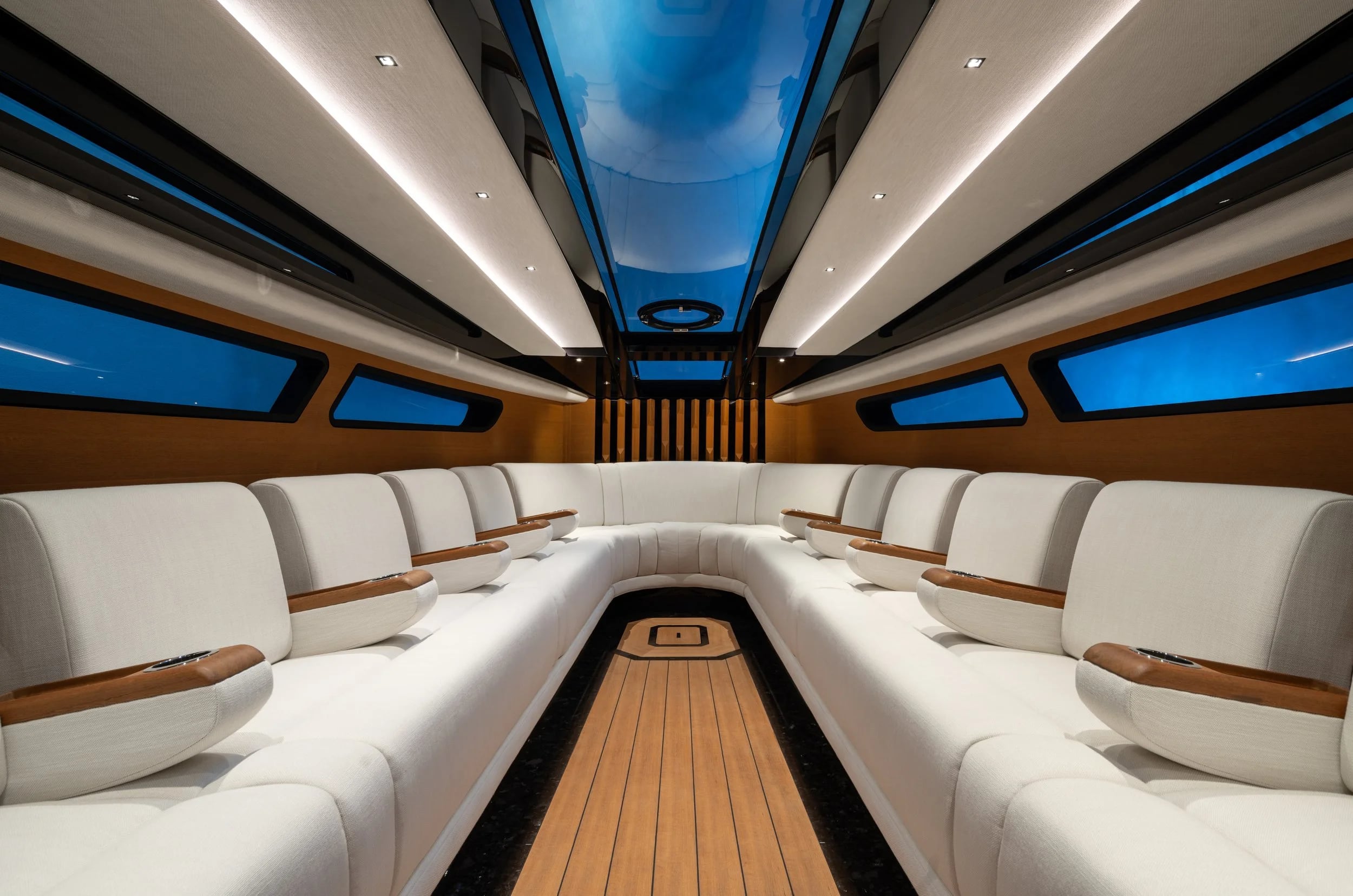
A 9 to 11m limo seats 8 to 12 guests on a single L-shaped or U-shaped settee, plus a small forward jump seat. A 12 to 14m boat seats 12 to 16 with a transverse aft bench and forward facing seats. The capacity ceiling is usually SOLAS or coastal-certification driven, not space driven.
The cabin furniture is the conversation that consumes the most owner time on a custom build. Materials, stitching pattern, headliner detail, hidden bar, drinks cooler, glass-stowage, USB-C and MagSafe charging integration, lighting scenes. Most builders run a finish allowance and bill the upgrade above it. Our cabin layouts spoke walks through the seating geometries that work and the ones that do not.
Limos are heavy boats for their length. A 10m limo runs 3,500 to 4,500kg loaded, against 2,500 to 3,200kg for an open tender of the same length. The drivetrain has to be sized accordingly.
Common configurations:
Hybrid and electric configurations are starting to appear at 8 to 10m, see electric and hybrid tenders. The technology is mature enough now for short-cycle limo work; range and recharge are still the binding constraint for longer runs.
Limos are the hardest tenders to fit through a garage door because the cabin sets the height. A 10m limo is typically 2.6 to 2.8m off the cradle, against 2.0 to 2.2m for an equivalent open boat. On a yacht with a 2.7m garage opening that is the difference between fitting and not fitting.
The detail that catches people out is launch-clearance height with the cradle raised and the door rolled up. The cabin headliner has to clear the door track, which often takes 100 to 200mm out of the available envelope. We cover the geometry in detail on tender garage sizing.
Working from a fixed garage envelope? Use the garage-fit finder to shortlist boats by length, beam, and height.
Open garage-fit finder →The limousine segment is concentrated. The main names:
Most owners shortlist three or four builders and move to a comparative spec exercise. We can run that comparison for you; see how to choose a superyacht tender for the framework.
Headline budget bands for a new limousine tender, before transport, commissioning, and finance.
The line items that move the headline are propulsion (jet vs sterndrive), interior finish allowance, and the air-conditioning and audio-visual fit-out. See cost of a superyacht tender for the full breakdown.
The brokerage market for late-model limos is shallow but active. A 5 to 8 year old limo from a well-known builder, properly maintained, retains 50 to 65 percent of its build value. A poorly maintained one or one from a builder with thin parts support drops to 30 percent quickly. We hold a small inventory; see the brokerage listings.
Before a contract is signed:
Anything the builder hesitates on becomes a problem in service. We run this conversation as a default part of the buying process.
Compare to open guest tenders, SOLAS rescue tenders, and the boats hub. To talk through a specific project, get in touch.
Explore
Read
Most tender purchases go wrong in the brief, not the build. This guide walks the buying process end to end, brief first, garage envelope second, propulsion third, yard shortlist fourth, contract fifth, the way we run it for owners.
ReadProduction, semi-custom and full-custom are not a quality ladder, they are three different commercial propositions. This guide defines each tier, what they cost, the lead times, and how to pick the right one for the brief before a yard is chosen.
ReadThe tender garage is the most expensive box on the yacht to get wrong, once built, stretching it means cutting structure. This guide works backwards from the tender envelope through the seven dimensions that actually decide which boat fits.
Library
A decision-ordered framework for specifying a limousine tender, from brief to builder shortlist.
ReadHardtop-removable and roof-retracting limos as the all-rounder when garage volume is tight.
ReadSeating layouts from 8 to 16 guests, the trade-offs that matter, and the questions to ask before signing a layout drawing.
ReadWhy air conditioning, heating, and glazing define whether a limousine tender actually delivers on its all-weather brief.
ReadAn overview of the yards that build enclosed cabin limousine tenders and how to shortlist one.
ReadWhy an enclosed climate-controlled limousine costs more than an open tender, the realistic price bands, and what it costs to run.
ReadThe length bands that work, why an enclosed cabin sets the floor, and how garage height decides what you can actually carry.
ReadHow the enclosed limousine tender and the open-air tender differ, and how owners and captains choose between them.
ReadA limousine tender is an enclosed, climate-controlled cabin tender built for formal, all-weather guest transfers.
Glossary
Destinations
The densest large-yacht harbour in the world runs a captain-led tender market that peaks hard around the Grand Prix.
FrancePort Vauban is the deepest tender-trade pool on the Med, and the calendar runs on Cannes and Monaco show prep.
SpainPalma is the deepest brokerage and refit market for superyacht tenders in Europe, and the western Med's busiest spring re-spec window.
Hong KongHong Kong holds Asia's largest resident motor-yacht fleet but limited deep-water berths, so most tenders work as anchorage shuttles.
Talk to us
Send the mothership, the programme, and the role you need filled. A shortlist follows within 48 hours.
Start an Enquiry →