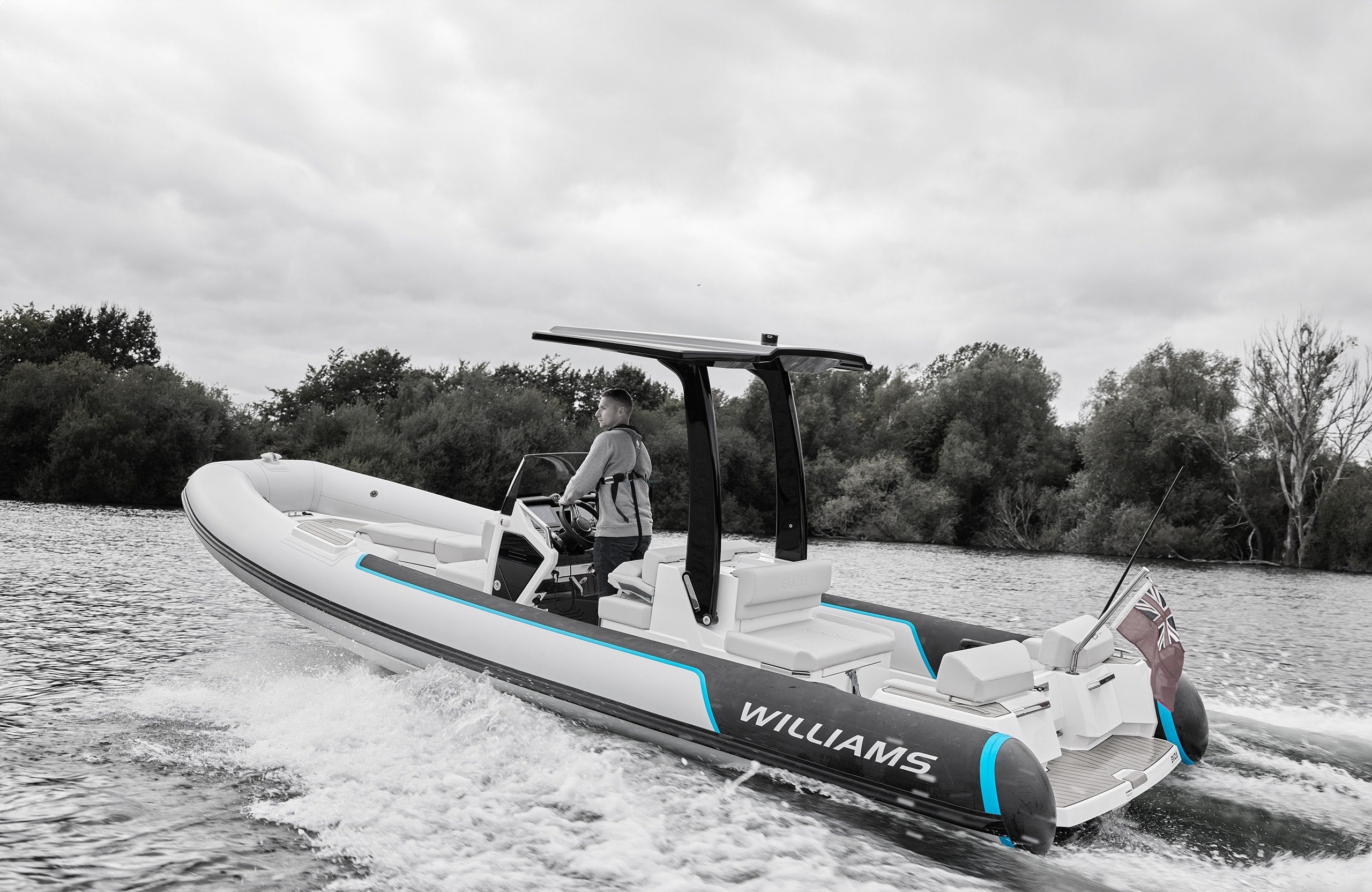
Williams · New build
Electric EvoJet 70e
7.1m
Length
35kt
Top Speed
13
People
Prices on request
Electric and hybrid tenders have moved from Monaco-show novelty to credible working boats. This guide covers what changed, the leading 2026 platforms, the real range and charging numbers, and how to decide between electric, hybrid and diesel jet.
For sale now
1 boat
Five years ago, every electric tender brief ended the same way: range too short, charging too slow, weight penalty too high, owners walked away. The category lived as a Monaco show novelty rather than a working tender option. That is no longer accurate. The current generation of electric and hybrid drivetrains, led by Vita, Candela, X Shore, Ingenity, and the hybrid lines from Williams and Pascoe, are now genuine working tenders for owners who fit the use case.
This guide covers what has changed, what has not, the dominant platforms in 2026, where they fit on the yacht, and how to decide whether your next tender should be electric, hybrid, or remain diesel jet. For the wider category, see the electric tenders spoke and the superyacht tenders overview.
Three things have shifted the electric tender market from novelty to credible option:
The market has not solved every problem. Cold-weather range still drops 20 to 30 per cent. Charging from a yacht's house bank can take 4 to 8 hours on a typical superyacht electrical system. And the upfront price premium over a comparable diesel tender remains 25 to 40 per cent. But the headline objection (you cannot get back to the boat) is largely gone for tenders used in their design envelope.
Owners ask three questions: how fast, how far, how long to charge. For the leading platforms in 2026:
| Platform | Length | Battery | Cruise | Range at cruise | Top speed | Charge |
|---|---|---|---|---|---|---|
| Candela C-8 | 8.5 m | 69 kWh | 22 kn (foil) | 57 nm (50 nm originally announced) | 27 to 30 kn | 6.5 h AC, under 30 min 135 kW DC |
| Vita Lion | 10.5 m | 235 kWh | 28 kn | 50 nm | 35 kn | 90 min DC fast |
| Vita SEAL | 10 m | 252 kWh | 25 kn | 50 nm | 35 kn | 90 min DC fast |
| Hodgdon Hull 415 | 9 m | 200 kWh | 22 kn | 40 nm | 30 kn | 2 to 3 hr DC fast |
| X Shore 1 | 6.5 m | 63 kWh | 20 kn | 40 nm | 30 kn | 90 min DC fast |
| Williams EJet | 4.85 m | 50 kWh | 18 kn | 25 nm | 28 kn | 60 min DC fast |
| MC-Zero 450 (ZeroJet/McConaghy) | 4.55 m | semi-solid-state (Safiery) | n/p | n/p | n/p | n/p |
| Navier 27 | ~8.2 m | n/p | foiling | ~75 nm | n/p | n/p |
| RS Pulse 63 | 6.3 m | 46 kWh | n/p | n/p | 23 kn | ~8 h |
| Lanéva | 7.9 m | 140 kWh | 15 kn | 40 to 45 nm | 25 to 30 kn | n/p |
| DutchCraft 25 | 8.04 m | n/p | n/p | ~75 min at speed | 32 kn | n/p |
| SAY 29E | 8.85 m | 360 kW (Kreisel) | n/p | n/p | 48 kn | n/p |
| Nautique GS22E | 6.7 m | 124 kWh | 20 kn | 30 nm | 38 kn | 90 min DC fast |
Candela and the lower block (Navier 27, RS Pulse 63, Lanéva, DutchCraft 25, SAY 29E) are per the BOAT International best-electric roundup and the Candela C-8 page; the MC-Zero 450, billed as the first twin-jet electric tender on ZeroJet 48 V 30 kW jets and a semi-solid-state battery, debuted at the Palm Beach show in March 2026 per Yachting Pages. "n/p" means the builder or source does not publish that figure: we leave it blank rather than estimate. Real-world range drops 15 to 25 per cent against published in typical Mediterranean conditions, more if the sea state pushes the foiling boats off-foil.
Hybrid tenders fall into two distinct architectures, and owners often conflate them:
A diesel engine and an electric motor sit on the same shaft. Either drives the boat. Electric mode gives silent low-speed manoeuvring (typically 4 to 7 knots) for marina entry and beach drops. Diesel mode runs the boat at full performance. The Williams Hybrid range and the Greenline H-Drive 6G on its larger sister yachts both work this way; Greenline reports up to 6.5 knots in electric mode using 23 kW motors between the diesel engines and propellers.
A diesel generator charges a battery; the battery drives an electric motor; there is no direct mechanical link from engine to propeller. More efficient at part load, less efficient at full throttle. Rare on tenders today; common on larger support vessels.
For a tender, parallel hybrid is the realistic answer. Owners get diesel range for the long runs, silent electric for the social moments. The penalty is weight (a hybrid Williams Sportjet is roughly 100 kg heavier than the equivalent dieseljet) and price (typically 20 to 30 per cent premium).
Electric tenders work for some briefs and not others. The fit map:
Strong fit:
Marginal fit:
Weak fit:
The honest brief picks the duty cycle first and the powertrain second. A primary tender that runs 15 nm a day three days a week is an obvious electric candidate. A primary tender that runs 100 nm to a fishing ground twice a week is not.
Electric tender performance depends on what is plugged in at the dock or in the garage. Three charging scenarios:
The lowest-stress scenario. A 32 amp 230 V AC charger feeds the tender's onboard charger; full charge takes 6 to 12 hours overnight. Adequate for short-range daily use, marginal for back-to-back long runs.
A 50 to 150 kW DC charger fitted in the garage and tied to the yacht's main switchboard. Charges from 20 to 80 per cent in 60 to 90 minutes. Adds significant electrical load to the yacht; needs gen-set or shore power management.
Increasingly available in major superyacht marinas (Port Hercule, Antibes, Porto Cervo, Palma, Antigua). 150 kW or higher, 60 minutes from 20 to 80 per cent. The fastest option but ties the tender to the dock.
For new builds, the right answer is to design the garage with a 50 kW DC charger and the yacht's electrical system to support it. Retrofitting later is possible but tedious. We cover this in detail in the tender garage sizing guide.
The capital premium for an electric tender is real (25 to 40 per cent over an equivalent diesel hull). The operating cost is lower, but not by as much as the brochures suggest:
| Cost line | Diesel jet 9 m tender | Electric 9 m tender |
|---|---|---|
| Capital cost | 800,000 EUR | 1,100,000 EUR |
| Annual fuel/electricity | 12,000 to 20,000 EUR | 2,000 to 4,000 EUR |
| Annual service | 8,000 to 12,000 EUR | 4,000 to 6,000 EUR |
| Battery replacement | n/a | 80,000 to 150,000 EUR at year 8 to 12 |
| Resale at year 5 | 60% of new | 50% of new (uncertain) |
The electric tender wins on running cost, loses on capital and on residual. The break-even is around year 7 to 9 for a heavily used boat, longer for an owner who runs the tender 30 days a year. The resale uncertainty is the real risk: there is no settled second-hand electric tender market yet, and the early adopters are taking depreciation hits that may or may not normalise.
For a wider operating cost view, see the cost of a superyacht tender page.
The credible 2026 electric and hybrid tender builders, with deeper coverage on each builder page:
Three trends to watch over the next 24 months:
None of these change the buying decision in 2026. They will start to within the life of a tender bought today.