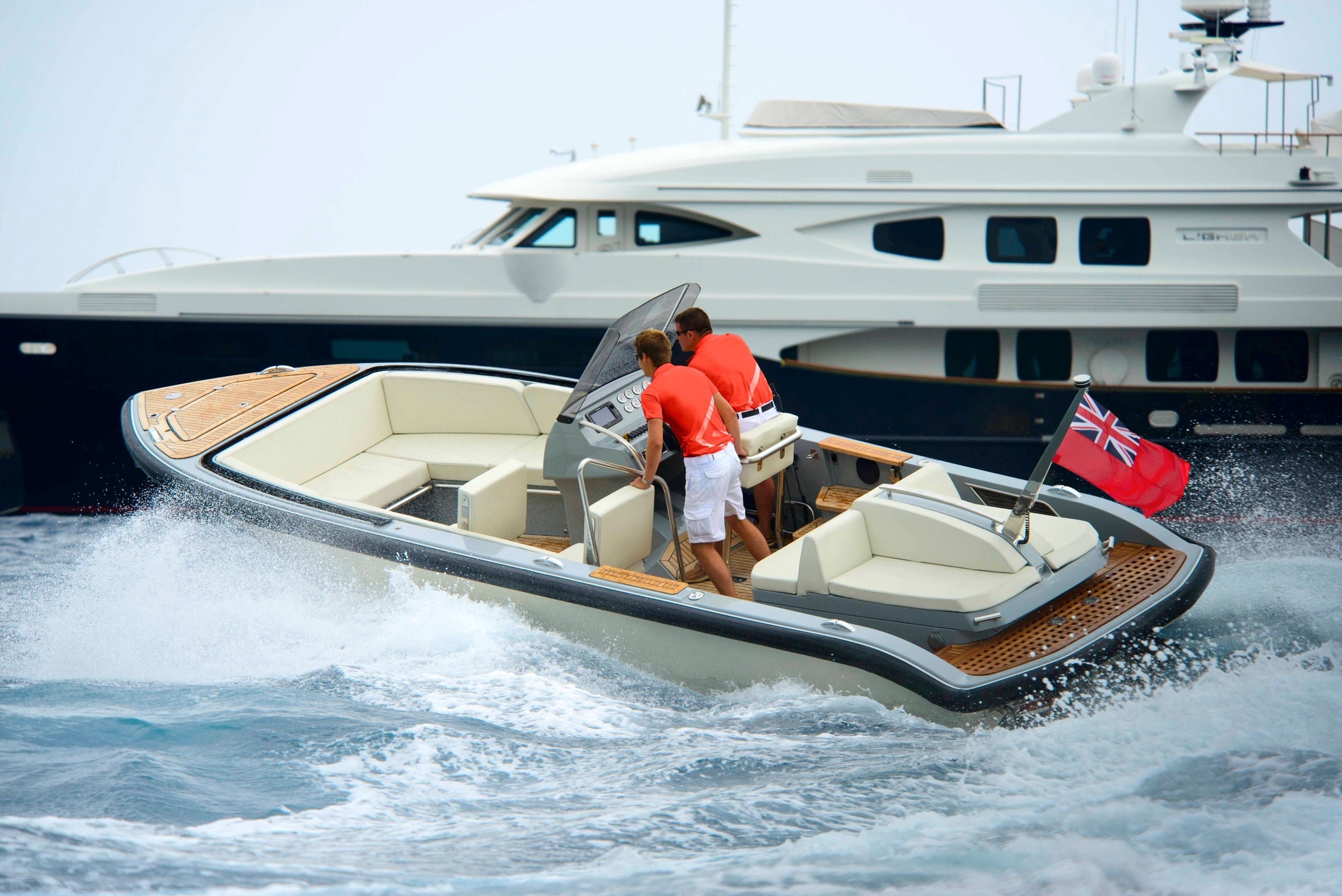
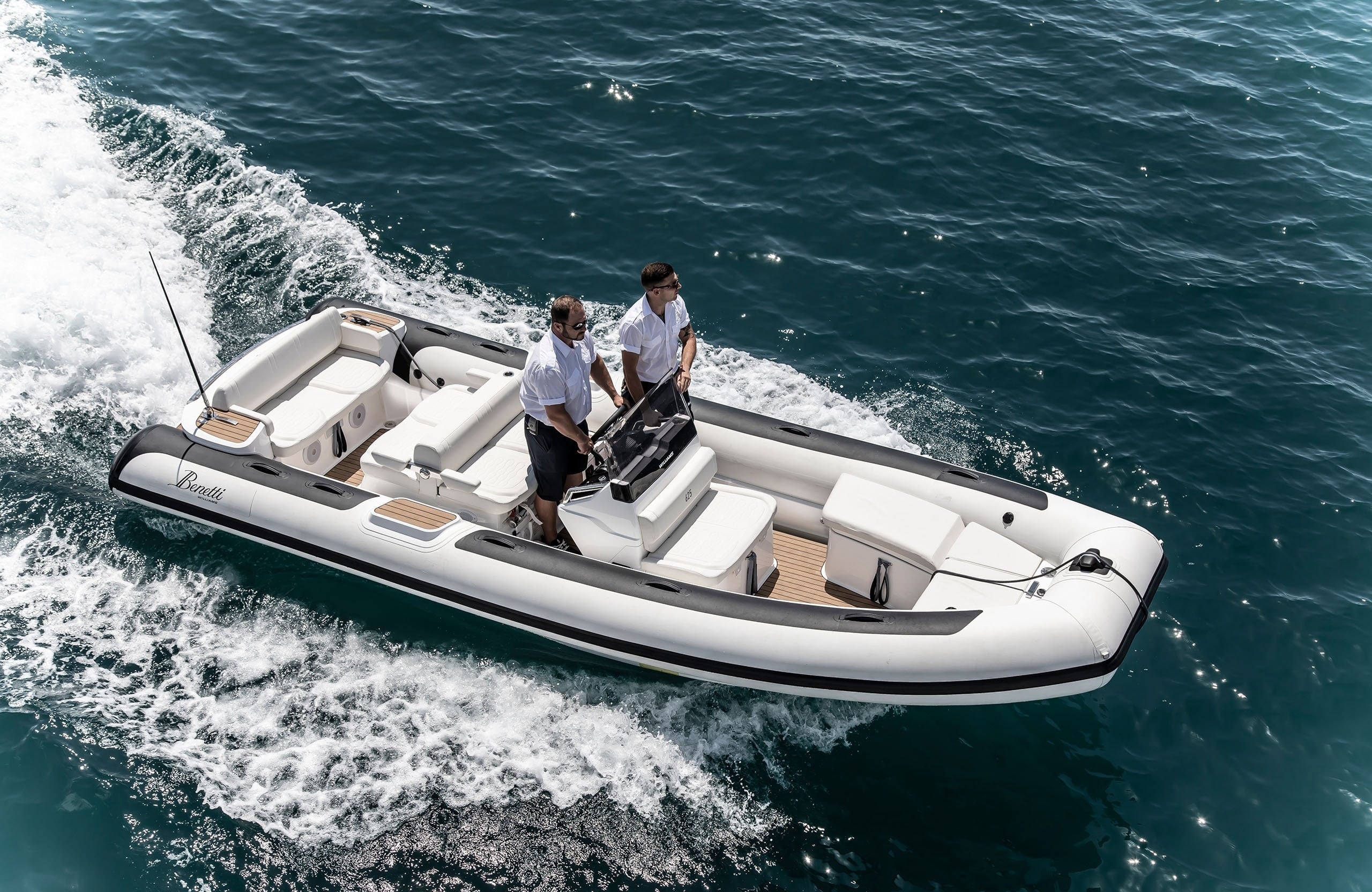
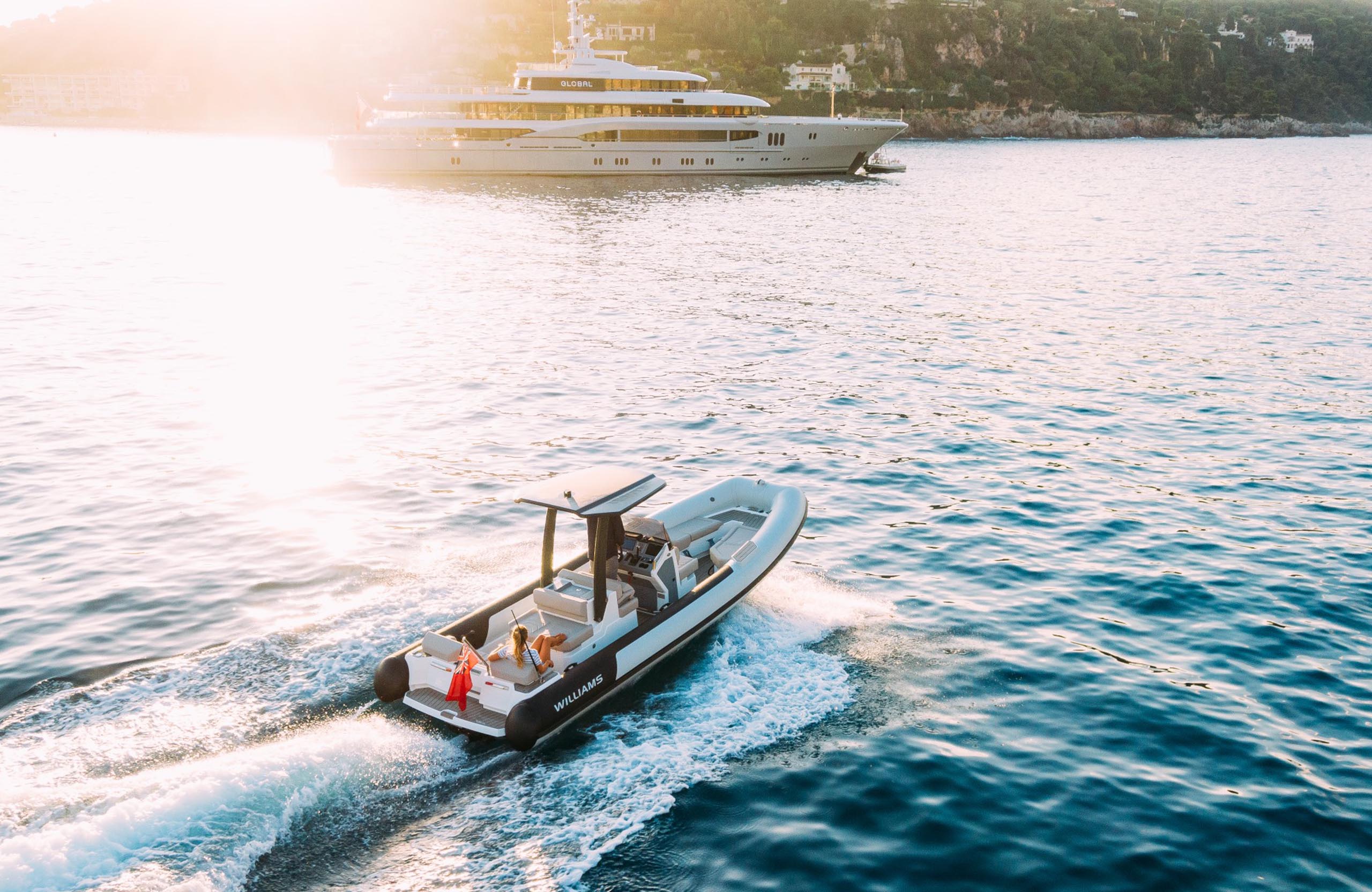
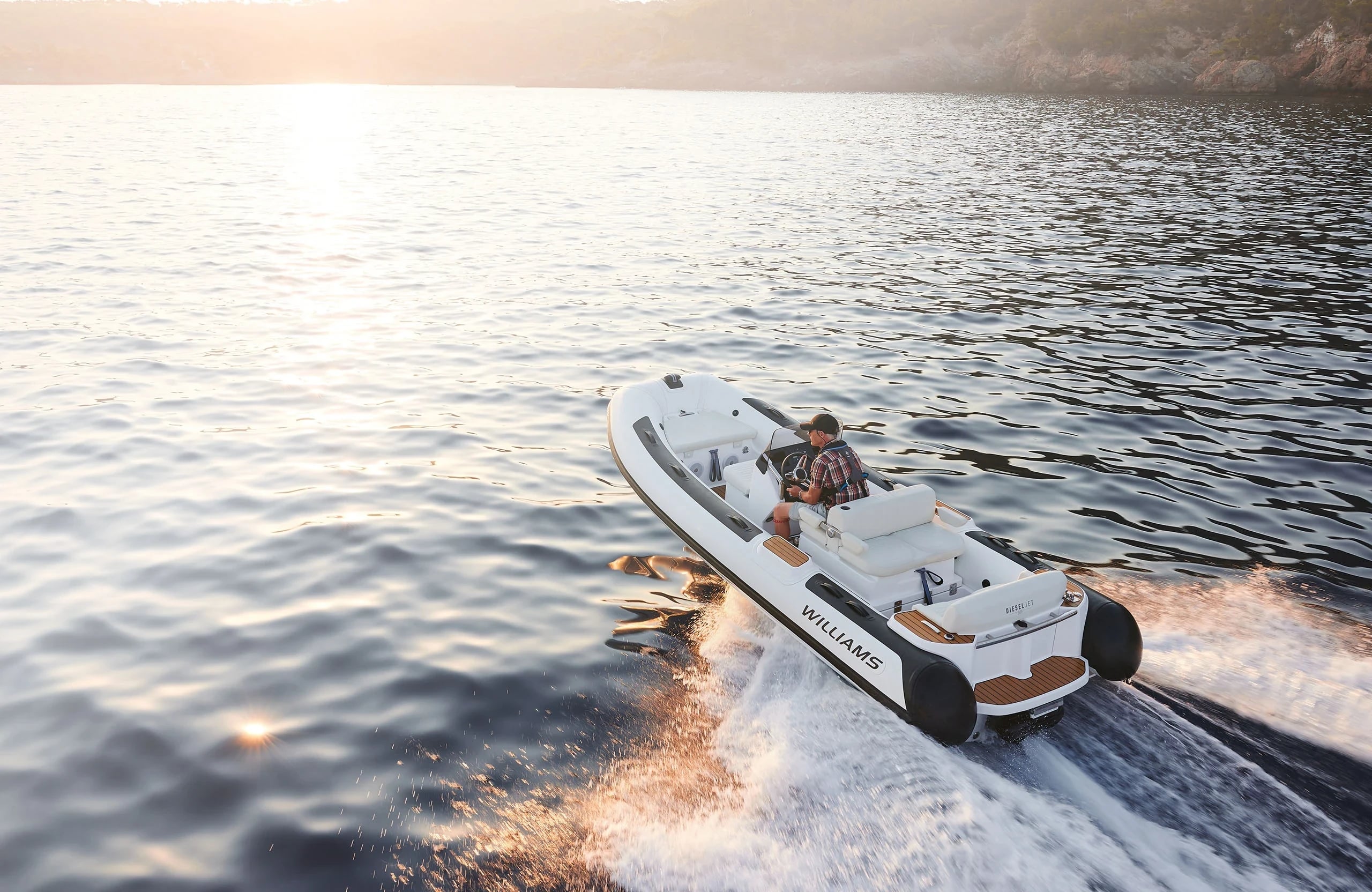
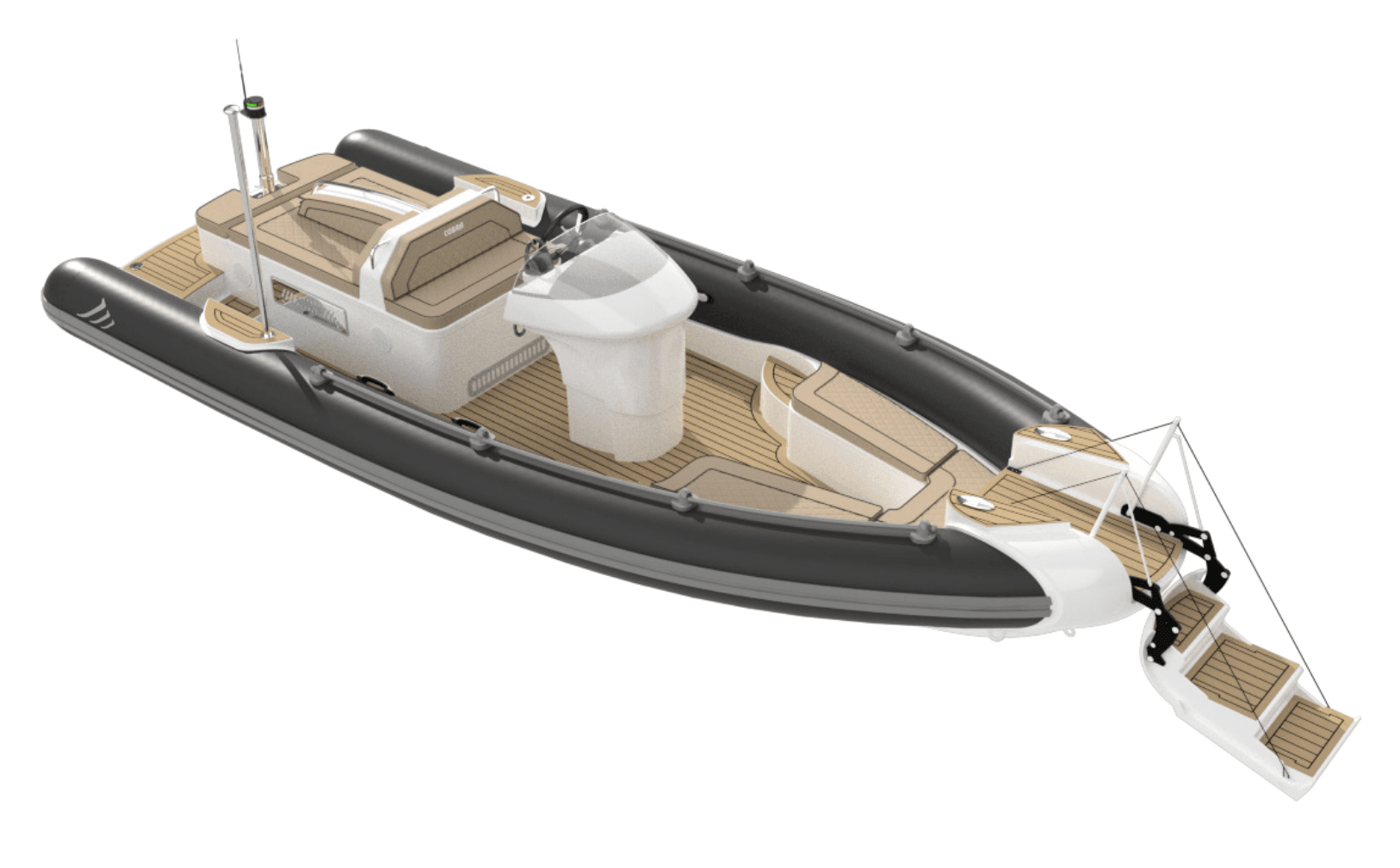
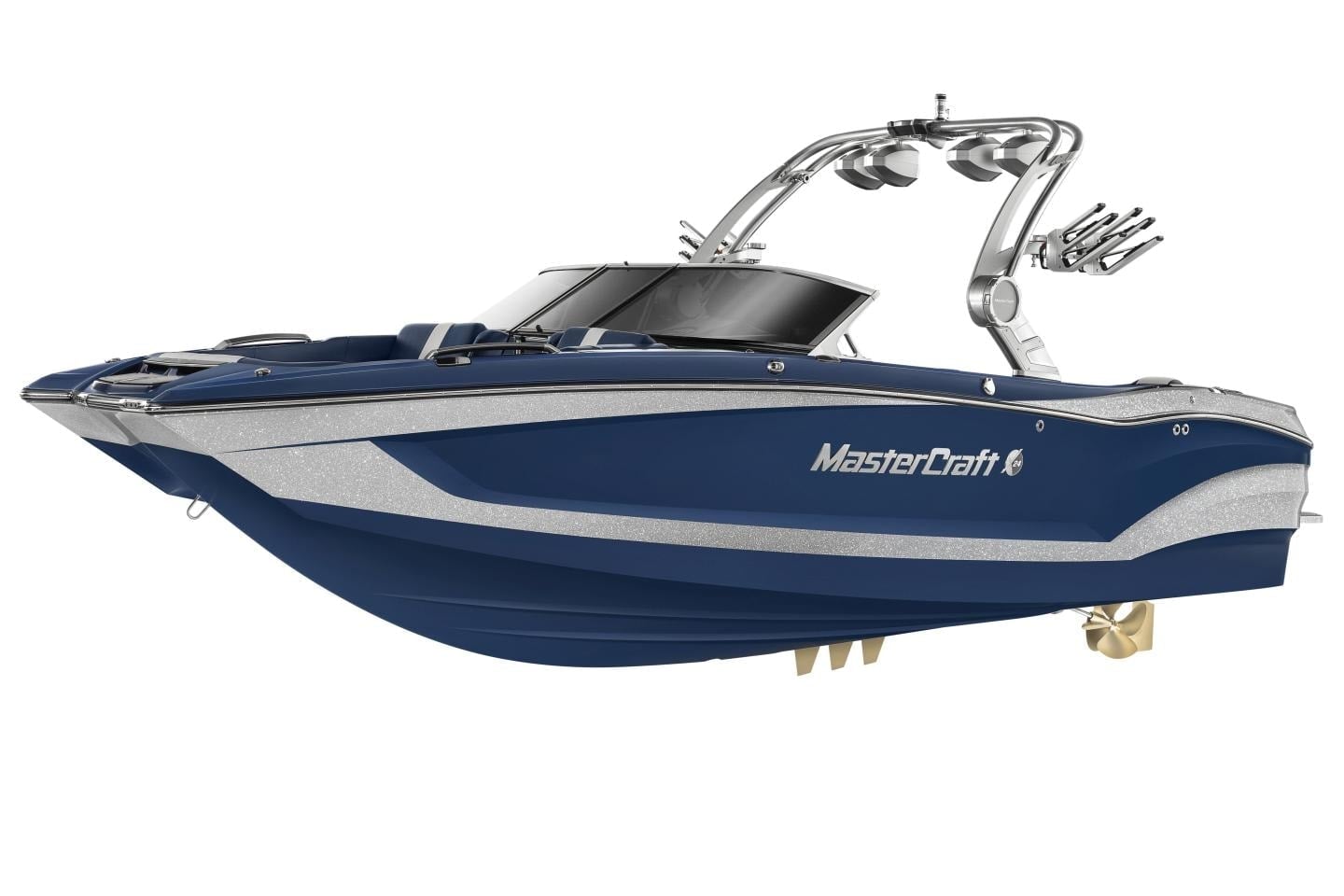
Propulsion is the tender decision owners think about last and that binds the most. It sets the draft (whether the boat can reach the beach), decides whether there is an exposed propeller at the swim platform, drives a large share of the loaded weight the davit has to lift, and governs cruise range and fuel burn. Get it wrong and no amount of finish recovers the brief. This guide is the cross-category decision; for the categories themselves start at the superyacht tenders overview, and to put specific boats side by side use the comparison tool.
The five drivetrains, and where each wins
Waterjet
No exposed propeller, very shallow draft, instant reverse and it dries out cleanly. That combination is why waterjet is the default on beach landers and the safest choice for guest RIBs that load people from the water. The trade-off is efficiency: the nozzle is not trimmable, so the hull cannot be held at its most efficient running angle and the jet is thirstier at cruise than a propeller for the same speed, per Discover Boating. Low-speed docking also takes practice because there is no rudder effect with the drive idling.
Sterndrive
The dominant choice on 9 to 12 m limousine tenders: efficient power transfer, trimmable for speed and economy, strong top end. The sterndrive leg is exposed, so it is poor for beaching, vulnerable to grounding damage, and a swimmer hazard at the platform; it also needs winterisation and outdrive servicing below the waterline, per Discover Boating.
Outboard
Lightest, simplest, easiest to swap, the best power-to-weight, and the most common drivetrain overall, especially on crew RIBs and chase boats under 15 m. Outboards win on weight (which the davit and cradle have to swallow), on the lowest acquisition cost and on simple repower, per Argos Nautic; they lose on the lower unit being exposed in shallow water and, historically, on transom aesthetics, though that gap has closed.
Shaft drive
Found on heavier 12 to 14 m limousines: efficient at cruise, quiet, durable, with the running gear protected inboard. Less manoeuvrable at low speed and a deeper draft than a jet. See shaft drive.
Surface drive and IPS
Surface-piercing drives buy top-end performance and appear on the fastest hulls; they are sensitive to debris. Pod drives such as IPS bring joystick docking and cruise efficiency to larger tenders. Both are specialist choices that should follow a clear performance or handling requirement.
Jet versus propeller, head to head
This is the highest-volume comparison, so it is worth a direct table. "Propeller" here covers sterndrive and shaft.
| Factor | Waterjet | Propeller (sterndrive / shaft) |
|---|---|---|
| Draft | Minimal, runs in very shallow water | Deeper, drive or shaft below the hull |
| Swim-platform safety | No exposed propeller | Exposed propeller, a swimmer hazard |
| Cruise efficiency | Lower (nozzle not trimmable) | Higher (trimmable running angle) |
| Beaching / grounding | Tolerant, dries out cleanly | Drive or shaft takes the damage |
| Low-speed docking | Harder, no rudder effect at idle | More intuitive, trim assists |
| Maintenance | Fewer underwater wear items, debris ingestion risk | Outdrive service, winterisation, prop and shaft wear |
Source for the efficiency and handling points: Discover Boating. The short version: jet trades cruise fuel for shallow draft and a clean, safe transom; propeller trades draft and platform safety for efficiency and range.
Waterjet versus sterndrive specifically
On a 9 to 12 m limousine the real fork is waterjet versus twin sterndrive: pick waterjet if the brief includes beaches, shallow anchorages or guests boarding from the water; pick sterndrive if the brief is long efficient transits in deeper water and fuel range matters more than draft.
Inboard versus outboard specifically
Below roughly 15 m the fork is outboard versus inboard. Outboard if weight against the davit SWL, simple service worldwide and lowest cost lead the brief (chase RIBs, crew boats). Inboard sterndrive, shaft or jet if a clean transom, cabin noise and cruise efficiency on a heavier limousine matter more than swap-out simplicity.
Indicative sizing by drivetrain
As one builder's product framing rather than an industry standard, Argos Nautic maps the drivetrains roughly as: outboard 11 to 14 ft hulls at 30 to 70 hp; jet around 9.5 to 11 ft at roughly 100 hp turbo; diesel 15 to 17 ft at around 110 hp Yanmar carrying up to about nine. Treat these as orientation, not a rule; superyacht tenders run heavier and more powerful than the recreational band.
How the categories actually specify it
The pattern that recurs across our briefs, drawn from the category libraries (these are our observed market patterns, not third-party figures):
- Limousines: twin sterndrive (Volvo Penta D6 IPS or DPI) is the mainstream on 9 to 12 m; twin diesel waterjet where shallow draft or beach access is needed; twin shaft on heavier 12 to 14 m hulls. The limousine tenders overview has the propulsion section in full.
- RIBs: outboard most common (Mercury V8 or V10 on larger guest and chase RIBs, Yamaha four-stroke on crew RIBs); jet increasingly specified on guest RIBs for swim-platform safety; sterndrive now the older spec. See the RIB tenders overview.
- Beach landers: twin waterjet dominant; surface-piercing occasional; twin outboard under 10 m. Conventional shaft-drive is not a beach lander.
- Chase boats: outboards under 15 m, diesel sterndrives or jets above. Outboards win on weight and serviceability, diesels on fuel burn and range. See chase boats.
- Electric and hybrid: direct-drive pod motors now make electric viable for short-cycle work; the electric and hybrid tenders guide covers where it fits.
The decision, in order
- Draft and beaching. If the brief includes beaches or shallow anchorages, waterjet leads and shaft is out.
- Swim-platform safety. Guests loading from the water points hard to waterjet.
- Weight. The davit and cradle have a fixed SWL; outboards are lightest. See tender garage sizing and davit systems.
- Range and fuel. Long transits and efficiency favour shaft or sterndrive over jet.
- Serviceability and the yard network. Outboards swap fastest; pod and surface drives need specialist support across cruising regions.
Fix the mission first, then the drivetrain follows. The complete guide to buying a superyacht tender sets the wider sequence, and the best superyacht tenders guide covers which builders execute each drivetrain well. To compare the propulsion packages on real boats, new or pre-owned, use the comparison tool and tell us the brief.