A limousine tender is sold on its cabin. The promise is that guests step off the superyacht in evening dress, sit in a quiet enclosed saloon, and step onto the dock dry, unruffled, and at a comfortable temperature regardless of what the weather is doing outside. Climate control is what makes that promise real. Get the heating, ventilation, and air conditioning right and the boat does the job. Get it wrong and you have an expensive glass box that fogs up, bakes in the sun, and chills in a Northern European spring. This guide covers how the systems work and what to look for. For the format itself, start at what is a limousine tender.
Why HVAC sits at the centre of the brief
A limousine tender exists to extend the season and the geography. An open tender is fine for a Mediterranean July beach run. The limo earns its place when the principal needs to arrive at a formal event in March, cross a wet anchorage in a squall, or run guests ashore in Gulf heat where the cabin would otherwise hit 45 degrees in minutes. The enclosed cabin is only an asset if the air inside it is controlled. That makes the climate system as load-bearing to the design as the hull or the driveline, not an accessory bolted on at the end.
The constraint is space and power. A tender has very little room for plant and a limited electrical budget when running off batteries or a small generator, so every kilowatt of cooling has to come from a compact, marinised unit that tolerates vibration, salt, and a hull pitching at 30 knots. That is the engineering problem the rest of this guide unpacks.
Air conditioning and heating
Two architectures dominate. Smaller limos, broadly under 10 to 11 metres, use self-contained direct-expansion units: a single box holding compressor, evaporator, and seawater-cooled condenser, ducted to the cabin. Larger or higher-end boats move to a chilled-water loop, where a central chiller cools fresh water that is pumped to one or more air handlers. Chilled water is quieter, scales better, and gives finer zone control, which is why it appears on the bigger custom limos.
Sizing is the thing owners underestimate. A useful rule of thumb from West Marine's marine air conditioning guide is roughly 14 BTU per cubic foot of conditioned space, adjusted up for glass area and heat-producing equipment. A limousine cabin is almost all glass and carries a full guest load, so it sits at the demanding end of that scale. The same guide makes a counter-intuitive point that matters here: an oversized unit cools fast but short-cycles and fails to dehumidify, leaving the cabin clammy and the windows fogged. Correct sizing beats raw capacity.
Heating usually comes from running the same unit in reverse cycle (heat-pump mode), which is efficient while sea temperature stays mild. In genuinely cold water the heat pump loses output, so cold-climate and shoulder-season boats add a diesel-fired hydronic heater or an electric strip in the air handler. Specify both if the programme ever runs outside the tropics.
Ventilation and air quality
Cooling is not the same as fresh air. A sealed cabin packed with eight guests builds carbon dioxide and humidity fast, and recirculating that air alone leaves it stale within minutes. A proper system blends a controlled amount of fresh outside air into the supply, filters it, and balances the cabin slightly positive so spray and exhaust fumes are pushed out rather than drawn in through door seals.
Distribution matters as much as capacity. Diffusers need to wash the glazing and reach footwells without blasting seated guests, and the return path has to avoid dead spots where humid air pools. On the better boats the cabin runs as one or two zones with their own thermostats so the principal's seating area can be set apart from the helm. Get the airflow geometry wrong and you can have plenty of cooling capacity yet still leave guests uncomfortable and the windscreen misting.
Glazing, demisting, and condensation
Glass is the limo's signature and its biggest thermal weakness. Large panes are a huge solar gain in the sun and a cold radiating surface in winter, and they are where condensation shows first. The serious boats attack this on three fronts.
- Better glass. Laminated and double-skinned glazing, often with a solar or low-emissivity coating, cuts solar heat load and keeps the inner surface warmer so it fogs less. It also helps acoustically, covered below.
- Demist ducting. Dedicated outlets aim conditioned, dehumidified air across the windscreen, the same principle as a car demister, to clear and hold the helm view in rain and cold.
- Dehumidification. Because air conditioning wrings moisture out of the air as it cools, a correctly sized system is itself the primary defence against fogging. This is the practical reason not to oversize: a too-large unit satisfies the thermostat before it has dried the air.
The failure mode to test for is a full, wet guest load on a cold morning. Eight people in damp jackets dump a lot of moisture into the cabin at once. A boat with marginal HVAC and single-skin glass will fog the windows immediately. This is worth checking on a sea trial rather than taking on the spec sheet.
Acoustic insulation
Comfort is thermal and acoustic. A formal arrival is undermined if guests have to raise their voices over engine and water noise. The same enclosed glazed cabin that needs climate control also wants quiet, and the two goals reinforce each other: laminated glass, sealed door gaskets, and insulated headliner panels all cut both heat transfer and noise.
The tension is that HVAC plant is itself a noise source. Compressors, pumps, and fans add a hum, and on a convertible limo tender the extra roof seals make both insulation and air conditioning work harder. Good builds soft-mount the plant, oversize the ducting to lower air velocity, and lag the lines. The target is a cabin where normal conversation is effortless at cruise. Cabin acoustics interact closely with seating and layout, covered under limousine cabin layouts.
What this costs and where it shows
A robust climate package is not free. The plant, the glazing, the insulation, and the integration all add build cost and weight, and they draw power that has to be planned into the generator or battery budget. We cover the wider numbers at limousine tender cost, but the short version is that climate control is one of the worst places to economise on a limo, because it is the system most directly responsible for the guest experience.
You can see how the better builders treat it on boats like the 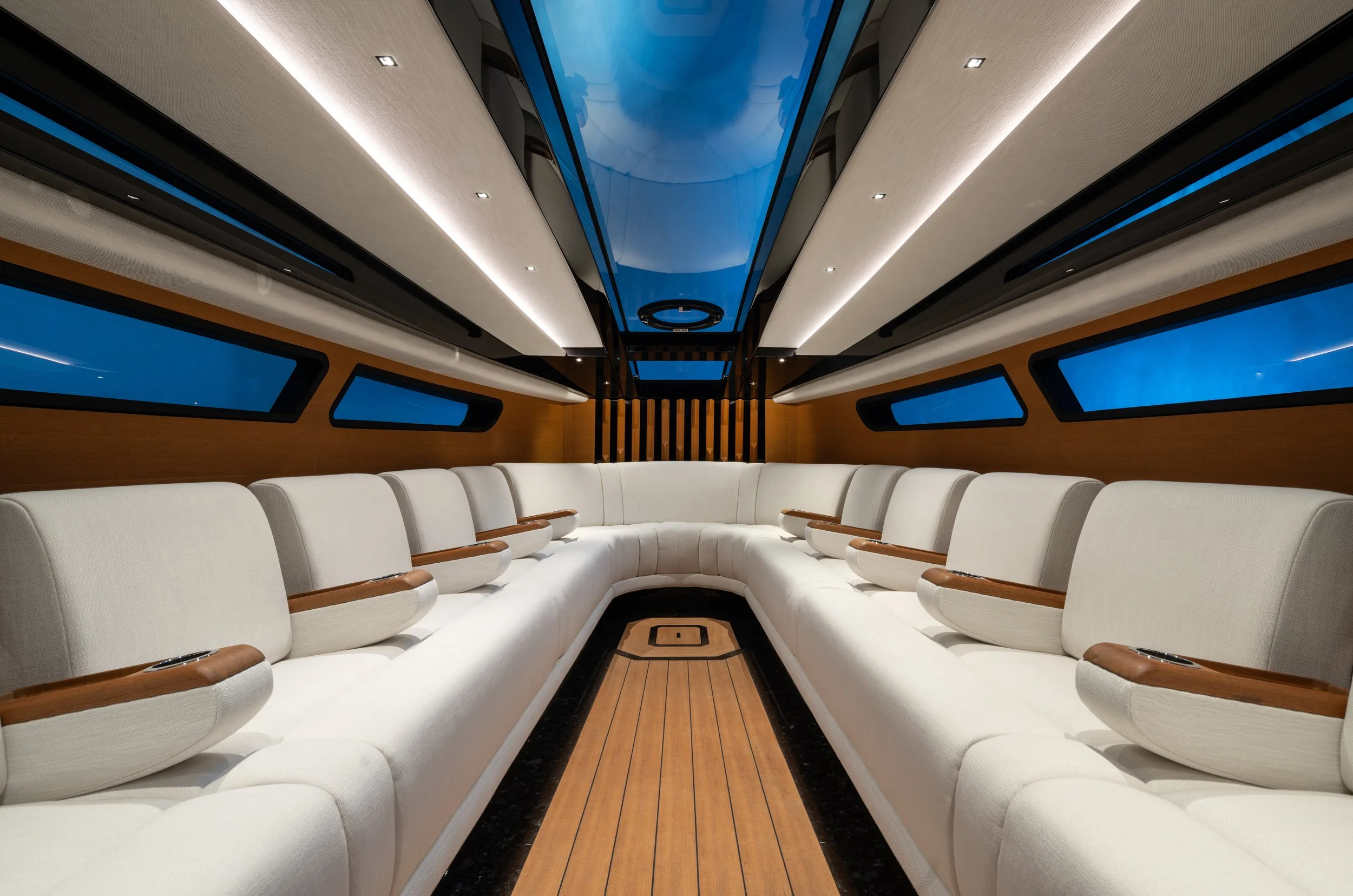 Pascoe · On the registerPascoe 10.4m TL LimousineLOA10.4mBeam2.95mTop Speed36knPrices on requestView on Superyacht Tenders → and the
 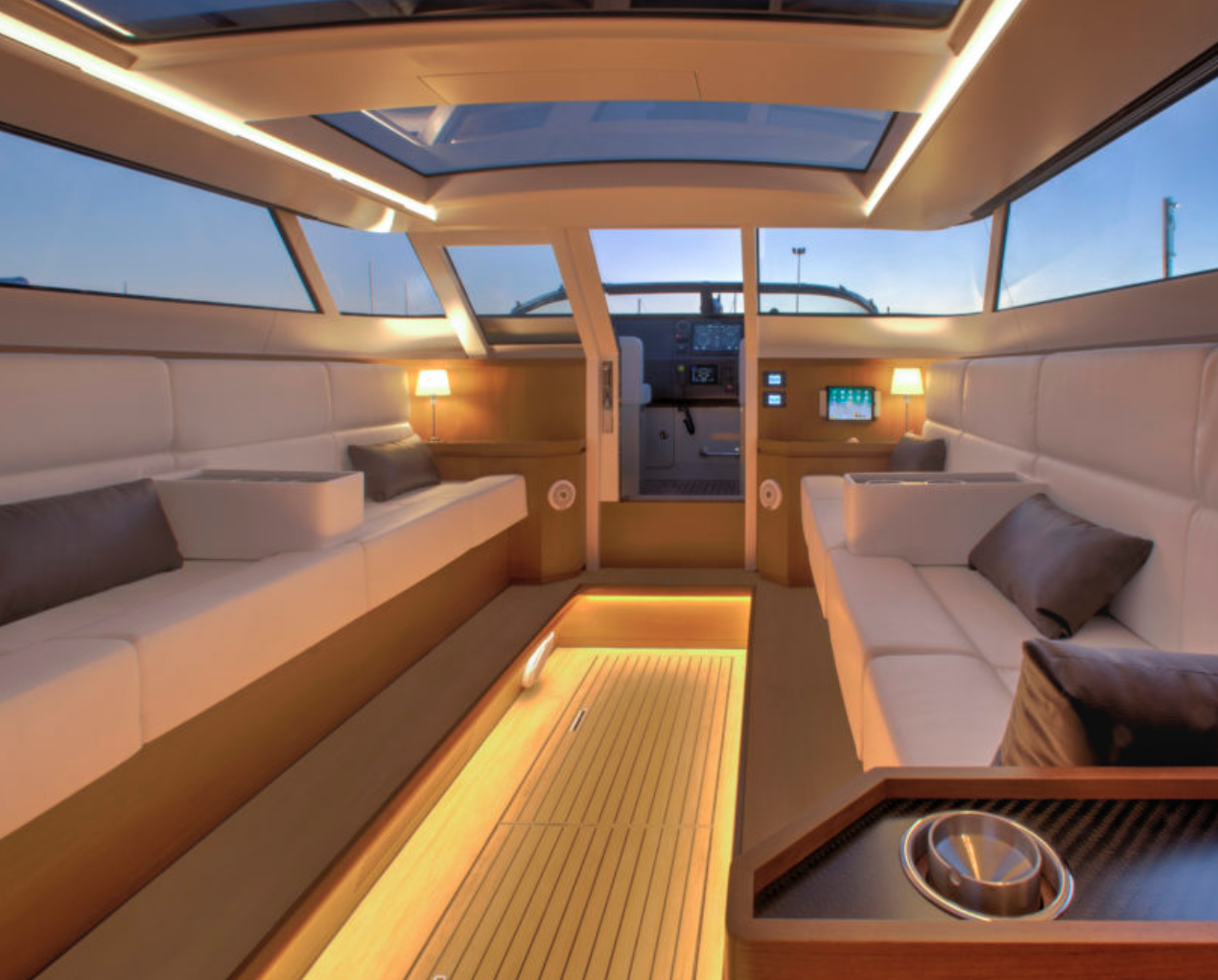 Reliant Yachts · On the registerReliant Yachts LimousineLOA11.5mBeam3.59mTop Speed35knPrices on requestView on Superyacht Tenders →, where the enclosed cabin, glazing, and HVAC are engineered as one system rather than assembled from parts.
What we tell clients
When a client is choosing between limos, we tell them to judge the climate system the way they would judge the engines, not as a feature box to tick. Three things separate a good package from a poor one. First, sizing: ask for cooling and heating capacity against the cabin volume and glass area, and be suspicious of a unit that is simply the biggest rather than the right size. Second, season and geography: a Med summer boat can run a lighter package than one expected to work a Northern European spring or a polar shoulder season, and the heating and demisting spec should match. Third, sea-trial it loaded and in poor weather, because a sunny empty-cabin demo tells you almost nothing about how the boat behaves with eight wet guests aboard.
If you are still deciding whether a limo is the right tender at all, read choosing a limousine tender and our best limousine tenders round-up, then come back to this once the format is settled. Climate control is the detail that decides whether the boat delivers, and it deserves the same scrutiny you give the hull.
Sources
- Reliant Yachts X40T Limousine official page — Reliant Yachts (retrieved May 2026)
- 10m Limousine | Luxury Tenders for Superyachts - Pascoe International — Pascoe (retrieved Jun 2026)