Short answer: Hypalon for hot-climate yacht service and easy repair, polyurethane where abrasion and weight matter most, PVC only for a budget or short-life tender.
The collar is the part of a RIB that defines its character: the inflatable tube that gives the boat its buoyancy, its fendering, and its soft contact against a yacht's hull. What that tube is coated with decides how long it lasts, how it survives a Mediterranean August, and how much a retube costs five years from now. Three materials dominate the market: Hypalon, PVC, and polyurethane. They are not interchangeable, and the right answer changes with where the boat works and how it is stored.
This guide compares the three on the criteria that actually matter for a yacht tender: UV and heat resistance, durability, repairability, weight, cost, and realistic lifespan. For how the fabric is built into a finished tube, the related read is RIB collar construction.
Hypalon (CSM): the hot-climate default
Hypalon is the trade name most people use for chlorosulfonated polyethylene, or CSM. It is not the fabric itself but a synthetic-rubber coating bonded to a woven base cloth, usually nylon or polyester. That coating is what gives the tube its working life.
In yacht service its defining strength is UV, ozone, and chemical resistance. The coating shrugs off direct sun and high deck temperatures without going hard, brittle, or chalky, which is exactly the failure that ends a tube's life in the tropics. A Hypalon collar that is rinsed, covered when idle, and kept off concrete will typically give 15 to 25 years, and well-cared-for examples run longer.
Hypalon is always bonded, never welded. The panels are sanded and glued with contact adhesive. That has two consequences. First, the boat is repairable anywhere: a clean puncture or a chafe through the outer coat can be patched on the swim platform with a repair kit and re-glued again later in life. Second, the adhesive does not reactivate in heat, so seams hold in climates where some glued PVC starts to creep apart.
The trade-offs are weight and cost. The rubber coating is heavier than PVC, and because the fabric has to be hand-sanded and glued rather than machine-welded, the labour is higher. Hypalon collars therefore sit at the top of the price range, which is reflected in RIB tender cost. For most owners running a tender in the Med or the Caribbean, that premium buys exactly the longevity they need.
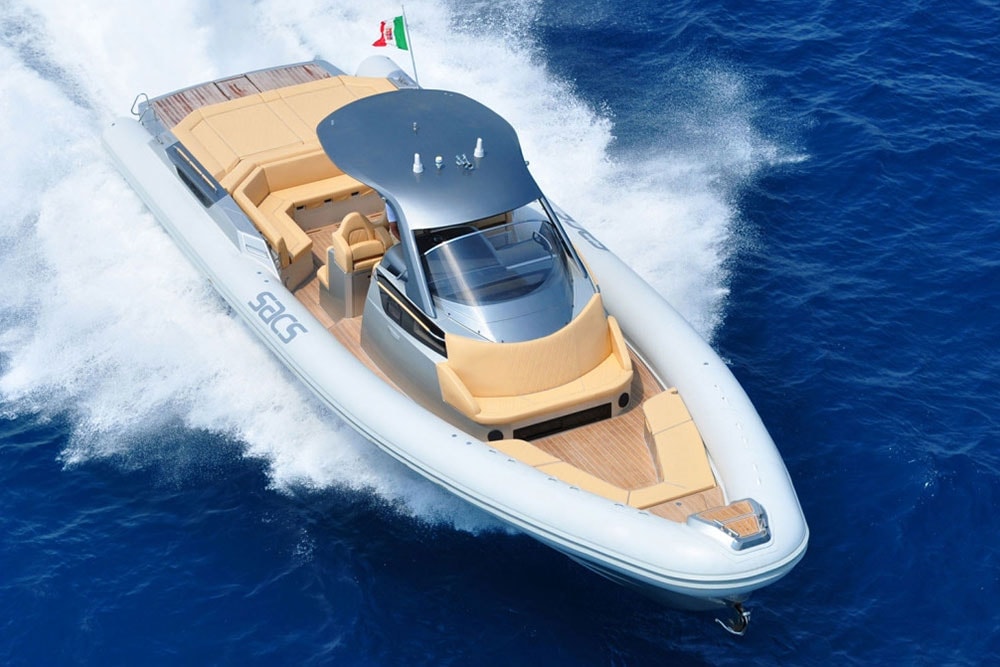 SACS · On the registerSACS Strider 15LOA15.0mBeam4.50mTop Speed42knPrices on requestView on Superyacht Tenders →
PVC: light, cheap, and climate-sensitive
Polyvinyl chloride is the volume material of the inflatable world. It is a plastic coating, again over a woven base cloth, and its appeal is straightforward: it is lighter than Hypalon, it costs less, and the seams can be thermo-welded by machine rather than hand-glued. Welded seams are clean, fast to produce, and on quality boats very strong.
The weakness is the sun. PVC relies on plasticisers to stay supple, and UV breaks those plasticisers down. As they migrate out, the fabric goes hard, crisp, faded, and mechanically weak. In a temperate climate a PVC tube can give a respectable 5 to 10 years. Parked on a yacht's foredeck in a tropical summer it ages far faster, and the cheapest grades can be tired in only a few seasons. Heat also matters at the seams: on glued (rather than welded) PVC, the adhesive can soften and creep in very hot service. RibFix, a UK retube specialist, notes that PVC's short life under sunlight is the single most common reason owners come to them for a new set of tubes (ribfix.co.uk).
For a yacht, PVC makes sense on light-duty or cool-water boats, on a low-hours backup tender, or where minimum weight on the crane or in the garage is the priority. As a hard-worked primary tender in a hot climate, it is usually a false economy.
Polyurethane (PU): the high-performance outlier
Polyurethane is the third option and, on paper, the most impressive. Modern PU fabrics resist UV and chemicals at least as well as Hypalon, sometimes better, and they are far more abrasion-resistant, which is why PU is the coating of choice for military and commercial RIBs that take real punishment. A good PU collar can run 20 years or more, and it can be welded rather than glued.
The catch is manufacturing. High-grade polyurethane fabric is harder to work and harder to source, so PU collars are comparatively rare on production yacht tenders and command a price that reflects the difficulty. Where you do see it is on the heavy-use end: chase-style RIBs, dive and dayboat platforms that ground on beaches, and anything where abrasion resistance is worth paying for. If your tender's life involves regular beach landings and rough handling, PU is the material that resists the kind of wear that quietly destroys a softer coating.
Comparison by attribute
A summary of how the three coatings stack up for yacht-tender service:
| Hypalon | PVC | Polyurethane | |
|---|---|---|---|
| UV and heat | Excellent in tropical sun | Hardens and fades in heat | Excellent in tropical sun |
| Abrasion | Strong | Trails, worse once UV-embrittled | Best |
| Field repair | Easiest, can be re-glued repeatedly | Needs the right kit | Needs the right kit |
| Weight | Heaviest | Lightest | Mid |
| Cost | A clear step up from PVC | Cheapest | Usually the most expensive |
| Lifespan in yacht service | 15 to 25 years | 3 to 10 years | 20 years plus |
These trade-offs run alongside the structural choices covered in RIB collar construction, and they feed directly into the decision framework in choosing a RIB tender. For the wider picture of what a RIB is and where it fits in a yacht's tender programme, start at what is a RIB tender.
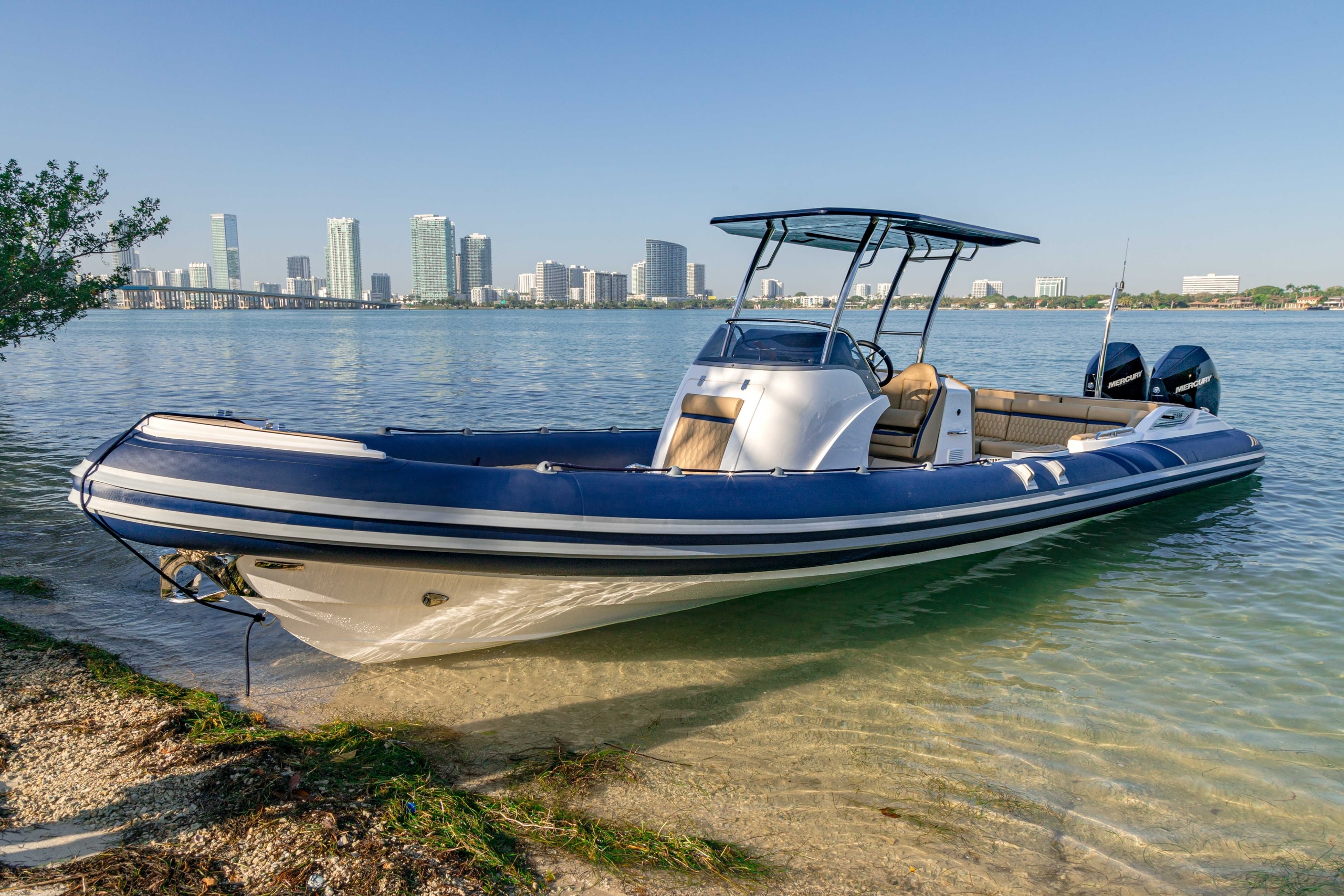 Cobra · On the registerCobra NAUTIQUE 9.7LOA9.7mBeam3.10mTop Speed58knPrices on requestView on Superyacht Tenders →
What we tell clients
For a tender that lives in the Mediterranean or the tropics, gets used hard, and is expected to look presentable for a decade or more, we steer owners to Hypalon as the safe default. The weight and cost premium is real, but it is repayment against a single fact: PVC does not survive that sun well, and a retube in year four is a more expensive outcome than the right fabric at order. Where the boat takes heavy abrasion, beach landings, and commercial-grade handling, polyurethane earns its place despite the higher price. PVC has a role, on light-duty boats, cool-climate use, or where every kilo on the crane counts, but it is the wrong specification for a hard-working primary tender in the heat.
Buyers weighing the whole package, hull, collar, and driveline together, will find the cross-checks in our best RIB tenders guide useful before committing to a build.